Turn Yourself Into a Medieval King or Queen Using AI
My nephew is twelve years old and completely obsessed with medieval history. Knights, castles, siege weapons, the whole thing. For his birthday last year I wanted to give him something he had never seen before. Not a toy, not a game — something that would genuinely stop him in his tracks.
I took a school photo of him, opened Gemini, and spent about forty minutes writing and refining prompts. What I ended up with was a portrait of my nephew as a young medieval king — crown on his head, chainmail and a royal tabard, seated on a stone throne in a candlelit great hall with a battle banner hanging behind him bearing a crest I had designed for his family name.
He stared at it for a full thirty seconds without saying anything. Then he said, very quietly, “that’s actually me.” He has it framed on his bedroom wall. He shows every friend who comes over.
That reaction told me something important: the medieval aesthetic hits differently from any other AI portrait style. There’s something about being depicted as a king or queen — crown, armor, stone throne, castle walls — that triggers a deep and genuine response in people. It feels like myth. It feels like the kind of image that should exist but somehow never has. Until now.
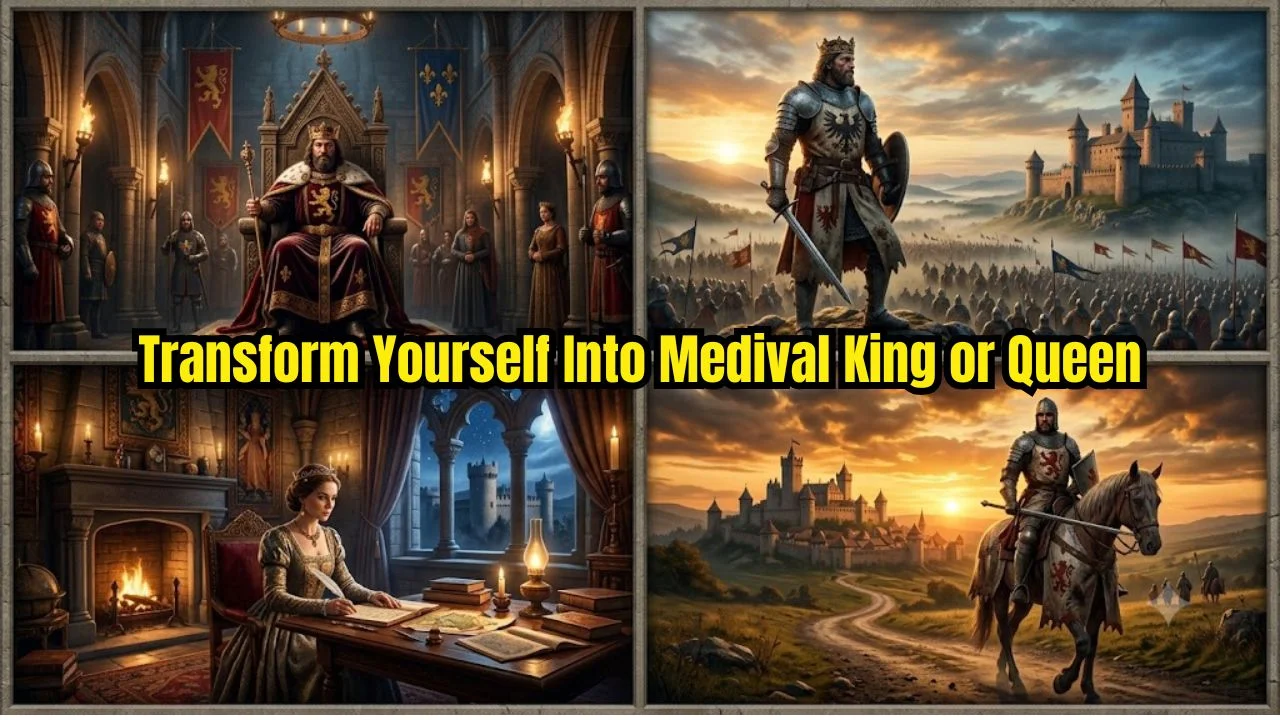
These four prompts cover the full range of medieval royalty — from a warrior king on a battlefield to an elegant queen in a candlelit throne room to a lone knight returning from war. Each one produces a completely different image with a completely different emotional quality. Try them all. You’ll find one that feels exactly like the version of yourself you always suspected existed somewhere.
Why Medieval Portraits Work So Well With AI
Medieval portraiture as a visual style is almost perfectly suited to AI image generation — and once you understand why, you’ll get better results from every prompt you write.
The medieval aesthetic is defined by strong visual codes — crowns, armor, stone, torchlight, banners, thrones, chainmail, embroidered surcoats, heraldic imagery. These are some of the most specific and recognizable visual elements in all of human history. AI models have seen these elements described and depicted in millions of images, paintings, films, and illustrations. When you describe them precisely in a prompt, the AI knows exactly what you mean and can render them with a high degree of accuracy.
The lighting of the medieval world — torchlight, candlelight, firelight — is also naturally dramatic and beautiful. There’s no overhead fluorescent lighting in a castle. Every light source flickers, casts deep shadows, and makes faces look sculptural and powerful. AI handles this kind of directional, warm, intimate lighting extremely well.
And finally — the settings are architecturally distinct and deeply evocative. A great hall. A stone tower. A castle battlements at dawn. A forest clearing with mist rising. These settings are immediately recognizable and emotionally loaded in a way that few other environments are. They signal to the viewer: something important is happening here. Something that matters.
How to Set Up Your Photos for the Best Medieval Results
Go to gemini.google.com and confirm you’re using Gemini 2.0 Flash or higher. Upload your photo — or two photos if you’re doing a couple or pair portrait — before pasting any of the prompts below.
These prompts work for individuals, couples, families, and even children — just adjust the number of people and gender references in the prompt to match. A single person becomes a solo king or queen. Two people become a ruling couple. A family becomes a royal household. The prompts below are written for a single person but adapt easily.
For medieval portraits specifically, a slight upward tilt of the chin in your source photo helps enormously. Medieval monarchs were always depicted looking slightly downward at the viewer — it communicates authority. If your source photo has you looking slightly up at the camera rather than down, the AI sometimes produces a portrait that looks more like a subject than a ruler. A neutral or slightly elevated gaze in the source photo translates into much more convincing royal authority in the result.
Also — don’t worry about what you’re wearing in the source photo. Of all the styles in this series, medieval is the one where the clothing transformation is most complete. The AI will replace whatever you’re wearing entirely with period-appropriate royal attire. A t-shirt becomes chainmail. Jeans become a royal surcoat. The source clothing is irrelevant — only your face matters.
The 4 Prompts — Four Different Medieval Rulers
Prompt 1 — The Throne Room King or Queen
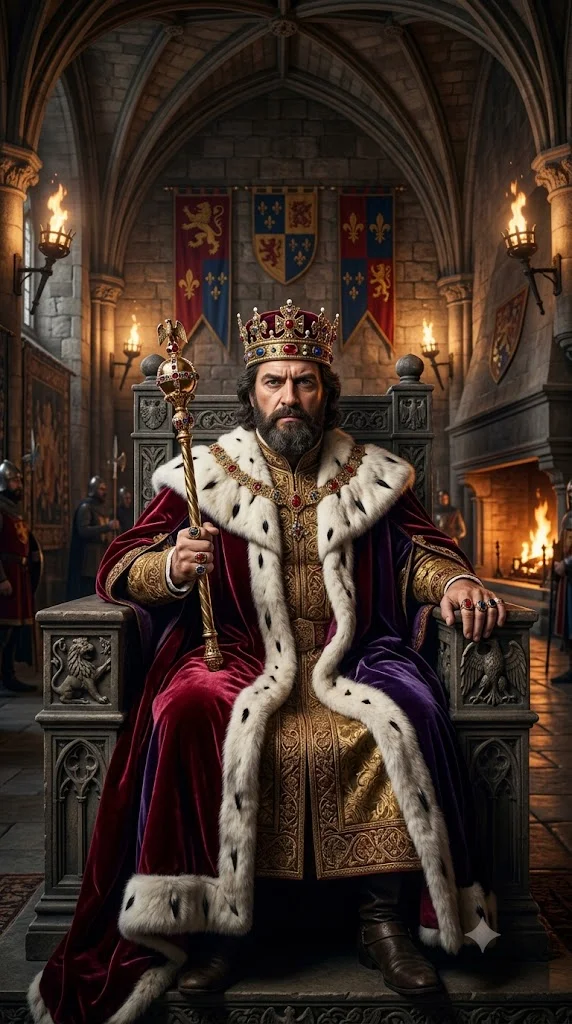
This is the foundational medieval royal portrait — formal, powerful, and immediately recognizable. The subject is seated on a stone throne in a great hall, fully crowned and robed, surrounded by the architectural grandeur of a medieval castle interior. It’s the kind of portrait that would have been commissioned by actual medieval monarchs to hang in palace great halls and assert their legitimacy. When done right, it looks completely authentic — the kind of image that makes people do a double-take and say, “wait, is that actually a real painting?”
Prompt:
I am uploading a photo of myself. Please transform me into a medieval monarch seated on a stone throne in a great hall. I should be depicted as a powerful ruling king or queen — my choice — seated upright on a large carved stone throne, dressed in full medieval royal regalia: a heavy crown of gold set with rubies and sapphires, a long ermine-trimmed robe in deep crimson or royal purple over chainmail or a richly embroidered surcoat, and formal leather boots. One hand should rest on the arm of the throne with authority; the other can hold a golden scepter. The great hall behind me should be magnificent — high vaulted stone ceilings, tall narrow windows with colored light filtering through, burning torches in iron brackets along the walls, a large stone fireplace, and a heraldic banner hanging behind the throne. The lighting should be entirely from torchlight and firelight — warm, flickering, casting dramatic shadows upward on the stone walls and across my face from below and to one side. My expression should be composed, commanding, and completely confident — the expression of someone who has ruled for twenty years and intends to rule for twenty more. Apply a warm painterly quality to the image — rich, slightly desaturated tones that suggest the visual language of medieval illuminated manuscripts or early oil painting. Preserve my real facial features from the uploaded photo. The final image should look like a commissioned portrait of a ruling medieval monarch — powerful, timeless, and undeniably regal.
Pro tip: You can personalize this portrait significantly by adding a heraldic detail. Before the final sentence of the prompt, add: “The banner behind the throne should bear a heraldic crest featuring [choose your symbol — a wolf, an eagle, a dragon, a lion] on a [color] background.” This small addition transforms a generic royal portrait into something that feels specifically yours.
Prompt 2 — The Warrior King on the Battlefield
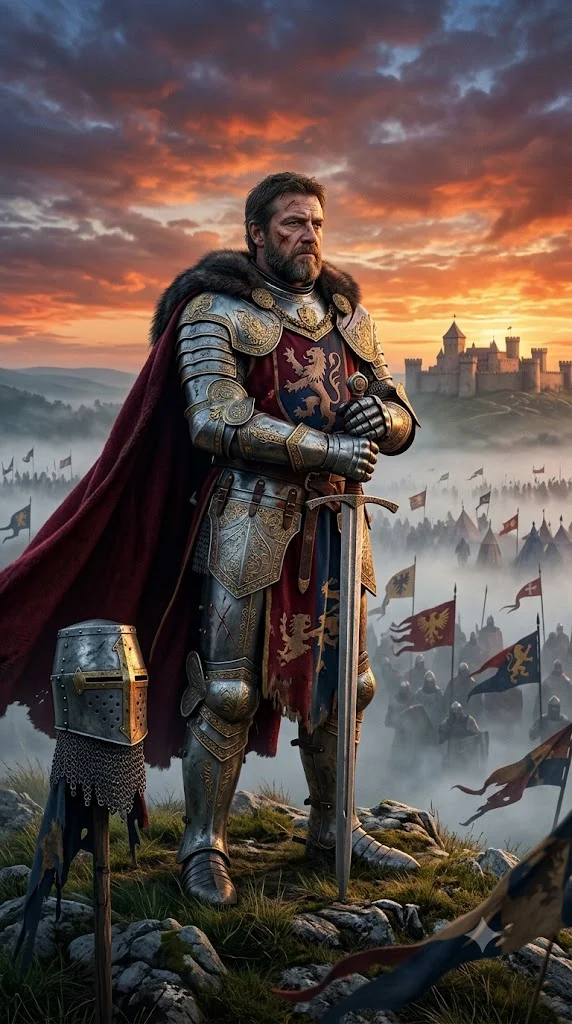
Medieval kings didn’t just sit on thrones. They led armies into battle, stood on the front lines, and were judged as much by their courage in war as by their wisdom in peacetime. This prompt captures that warrior-ruler archetype — the king in full battle armor, on horseback or standing on a hilltop at dawn, with a battlefield or a castle siege visible in the distance behind them. It’s more cinematic than the throne room portrait — more like a movie still than a formal commissioned painting — and it produces some of the most visually stunning results in the entire medieval category.
Prompt:
I am uploading a photo of myself. Please transform me into a medieval warrior king standing on a hilltop at dawn, surveying a battlefield. I should be depicted in full medieval battle armor — polished plate armor with intricate engravings, a surcoat bearing a heraldic crest, heavy gauntlets, and a great helm held in one arm or resting at my side. A broadsword should hang at my belt or be held upright in one hand, point resting on the ground. Behind me, the landscape should show a dramatic medieval battlefield at dawn — mist rolling across a wide valley, the distant shapes of castle towers on the horizon, banners of an army visible in the fog below, and a sky in deep orange and red dawn light breaking over the hills. The lighting should be cinematic and dramatic — cold dawn light from one side creating hard shadows across the armor, the metal catching and reflecting the orange dawn glow. My expression should be resolute, battle-hardened, and completely calm — the expression of a commander who has seen worse than this and won. The overall tone should feel cinematic and epic — like a still from a major historical fantasy film. Apply rich, slightly desaturated cinematic color grading to the whole image. Preserve my real facial features from the uploaded photo. The final image should feel like a portrait of a legendary warrior king at the moment before his greatest victory.
Pro tip: The dawn battlefield lighting in this prompt produces the most dramatic color contrast of all four results — deep orange and gold against cold blue-grey armor. It makes an extraordinary desktop wallpaper and performs very well as a Pinterest pin because the cinematic quality stops scrollers immediately. If you’re pinning one image from this article, make it this one.
Prompt 3 — The Elegant Medieval Queen in Her Tower
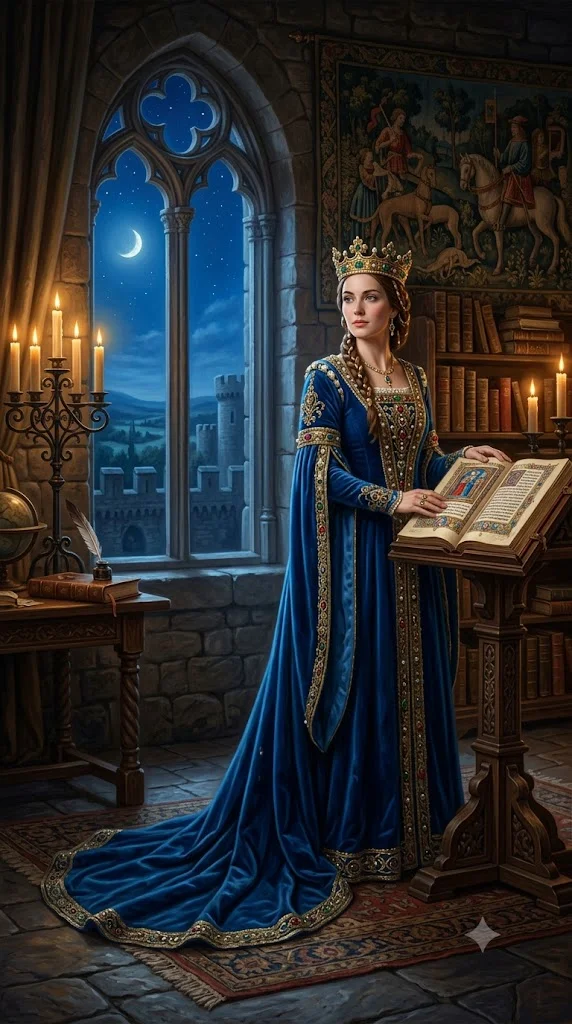
Medieval queens have a very specific visual tradition that is different from kings — more intimate, more layered, more mysteriously beautiful. The tower chamber setting, the candlelight, the elaborate headdress and gown, the sense of a powerful woman in a world that underestimates her — all of it combines into an aesthetic that is deeply compelling and visually stunning. This prompt is written specifically for a queen but works equally well for anyone regardless of gender who wants the more refined, interior, candlelit version of medieval royalty.
Prompt:
I am uploading a photo of myself. Please transform me into a medieval queen standing in a castle tower chamber. I should be depicted in full medieval queen’s regalia — an elaborate gown in deep jewel tones with a long train, intricate gold and gemstone embroidery at the collar and cuffs, long fitted sleeves, and a tall elegant hennin headdress with a sheer veil, or alternatively an ornate gold crown set with emeralds and pearls. I should be standing near a tall narrow stone window through which cold blue moonlight or early morning light filters in, casting long shadows across the stone floor. In one hand I can hold a rolled parchment or rest my fingers on an open illuminated manuscript on a reading stand beside me. The chamber should suggest learning and power — stone shelves with leather-bound books, a tapestry on the wall depicting a medieval hunting scene or coat of arms, and several tall candles burning in ornate holders. The lighting should be a beautiful interplay of warm candlelight from inside and cool blue light from the window — the two meeting on my face and creating a hauntingly beautiful, layered illumination. My expression should be intelligent, composed, and self-possessed — the expression of a woman who runs this kingdom whether or not anyone realizes it. Apply a warm, slightly painterly quality — the aesthetic of a Flemish or Italian medieval painting. Preserve my real facial features from the uploaded photo. The final image should feel like a portrait of a medieval queen at the height of her power and intelligence.
Pro tip: The candlelight and moonlight dual-lighting in this prompt produces some of the most visually sophisticated results of the entire series. The warm and cool light meeting on the face creates a depth and beauty that the single-source lighting prompts don’t achieve. If you want the most artistically striking medieval portrait, this is the one to try first.
Prompt 4 — The Knight Returning From Battle
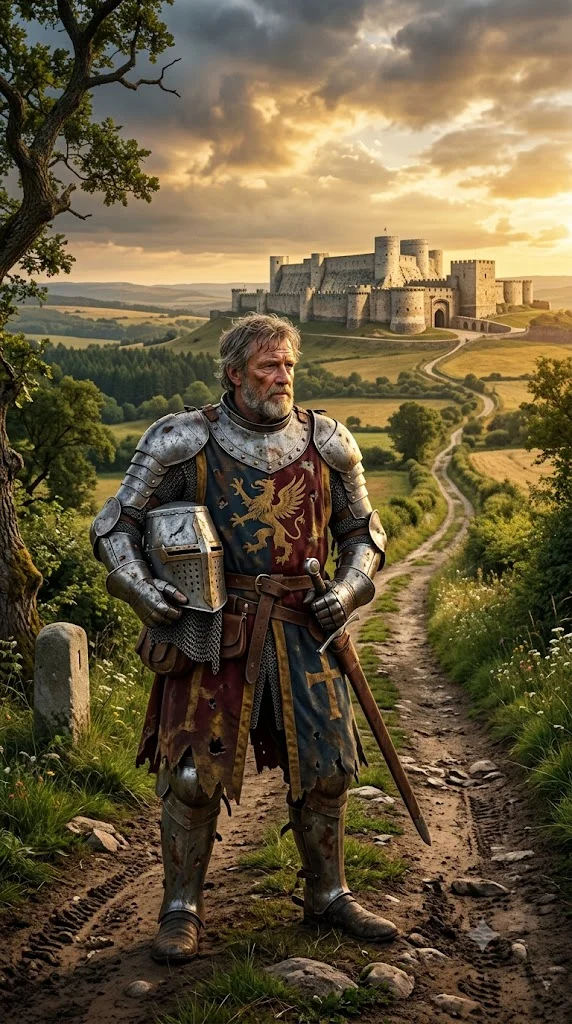
Not every medieval portrait needs a crown. Some of the most powerful medieval imagery is about the knight — the warrior who serves something larger than himself, who has seen terrible things and carried them with quiet dignity. This prompt places you as a battle-worn knight at the end of a long campaign — armor dented and scarred, a castle visible in the distance behind you, the war finally over. It has a different emotional quality from the other three prompts — less about power and more about endurance. And that makes it surprisingly moving.
Prompt:
I am uploading a photo of myself. Please transform me into a battle-worn medieval knight at the end of a long campaign. I should be depicted in heavy plate armor that shows signs of battle — dents, scratches, and scorch marks that tell the story of the fight. A heraldic surcoat over the armor should be slightly torn and dusty. My great helm should be held in one arm, my face fully visible. A broadsword hangs at my belt, its hilt worn smooth from years of use. I should be standing on a road or path leading toward a castle in the distance — the gates visible through the late afternoon light, a hint of home after a long absence. The sky behind me should be wide and dramatic — golden hour light breaking through dark storm clouds that are finally clearing, casting a warm hopeful glow across the landscape. The lighting on my face should be that warm golden light from the clearing sky — soft and beautiful after whatever came before. My expression should be tired but unbroken — someone who has done what needed to be done and is finally coming home. The color palette should be rich but weathered — deep steel greys, warm gold, earth browns, the green of a countryside finally at peace. Apply a cinematic quality to the whole image — the visual language of a serious historical epic. Preserve my real facial features from the uploaded photo. The final image should feel like the last scene of a great medieval story — quiet, earned, and deeply human.
Pro tip: This is the most emotionally resonant prompt of the four and often the one people respond to most deeply — even more than the crowns and thrones. The battle-worn detail, the distant castle, the clearing sky — it tells a complete story in a single image. It also makes an extraordinary gift for someone going through a difficult time, or for a person who has recently overcome something hard. The metaphor lands without needing to be explained.
Getting the Medieval Details Right — What to Watch For
The most common issue with medieval AI portraits is anachronistic details — elements that don’t belong to the medieval period sneaking into the result. Modern glasses frames suggested by the source photo. A watch strap still visible at the wrist. Hair styled in a way that doesn’t match the era. These small details immediately break the illusion.
If you wear glasses in your source photo, add this line to your prompt: “Do not include glasses — depict the subject without eyewear as appropriate for the medieval period.” For any other modern detail that keeps appearing, simply name it specifically in a follow-up instruction: “Remove any modern elements from the image — everything visible should be period-accurate to medieval Europe.”
The second most common issue is armor that looks plastic rather than metal. This happens when the lighting isn’t dramatic enough to create the reflections and shadows that make steel look real. Fix it with: “Make the armor look like genuine polished steel — it should reflect the surrounding light sources with realistic metallic sheen, showing the weight and texture of real plate armor.”
And if the background setting doesn’t look medieval enough — stone that looks too clean, architecture that looks too modern — add: “The stone work and architecture should look authentically medieval — rough-hewn, aged, and massive, consistent with 13th or 14th century European castle construction.”
Who These Portraits Are Perfect For
The obvious answer is anyone who has ever watched Game of Thrones, played a medieval RPG, read a fantasy novel, or walked through a castle and thought — even for a half-second — “I could have ruled here.” That covers a lot of people.
But beyond the obvious fantasy audience, these portraits make extraordinary gifts for specific types of people. History teachers and professors who would genuinely appreciate seeing themselves as a medieval monarch. History-obsessed children and teenagers like my nephew. Couples who want an anniversary gift that is genuinely unlike anything they’ve ever received. Gamers who play medieval RPGs and would love to see their real face in their fantasy world. Renaissance fair enthusiasts who would frame this immediately.
The Knight Returning portrait specifically works as a gift for someone who has recently finished something difficult — a military deployment, a medical challenge, a grueling professional period. The imagery of the battle-worn knight coming home resonates with that experience in a way that goes beyond aesthetics. It says: you fought. You endured. You’re still here. That is worth commemorating.
Printing and Displaying Your Medieval Portrait
These portraits were built to be printed large. On a phone screen they’re impressive. On a wall, they’re something else entirely.
For the Throne Room and Queen’s Tower portraits, print at 16×20 or larger on canvas — the texture makes the painterly quality of these images look like genuine oil paintings. Frame in a dark ornate wood frame for maximum impact. CanvasPop and Easy Canvas Prints are both excellent for this.
For the Warrior King and Knight Returning portraits, the cinematic quality actually looks best on lustre or metallic photographic paper — the sheen enhances the metal armor and the dramatic lighting. Nations Photo Lab and Mpix both offer excellent metallic print options.
For framing the warrior and knight portraits specifically — a simple, heavy dark wood or black metal frame without ornate detailing actually works better than an elaborate gold frame. The cinematic aesthetic is clean and stark. An elaborate frame competes with it. A simple heavy frame completes it.
The Version of You That Has Always Been There
My nephew still has his medieval king portrait on his bedroom wall. He is thirteen now and has started writing a fantasy novel set in a medieval kingdom. I do not think this is a coincidence.
There is something that happens when you see yourself depicted with genuine power and dignity in a world that is larger and older than the one you actually live in. Something shifts. You see a version of yourself that you didn’t know how to imagine before, and then you can’t stop imagining it.
That’s what these prompts are for. Not just a cool image — though they are genuinely cool images. But the specific experience of seeing your own face and knowing: yes, that’s me. That has always been in there somewhere.
Upload your photo, pick your prompt, and find out which medieval ruler you’ve been all along. Drop your result in the comments — I want to see every single one.